
Matching Business Financing to Your Clients’ Needs
Seasonal inventory, recurring expenses, expansion or a commercial property purchase: how to match each client need to the Loanspark program that fits.
Consider two clients, each requesting $60,000. The first needs cash to complete a single inventory order ahead of the holidays; the second needs to cover supplier invoices that fluctuate month to month. The number is the same; the rhythm of the need is not, and the rhythm is what points to the right structure.
Loan size is the easiest number to focus on, and risk, term, collateral and the borrower’s profile shape what a loan costs. On their own, though, none of them tells you which type of loan fits. How the client will actually use the money does.
You don’t need to be a lender to see it. Knowing how the main options work is enough to narrow the field and make a more targeted introduction.
The four situations below are hypothetical, but you’ll probably recognize them. Each shows where one of Loanspark’s current programs fits, and the detail that can change the answer.
When Inventory Costs Come Before Seasonal Sales: Short-Term Business Loans
Take the first client: a gift shop that makes most of its sales between October and December. To stock up, it needs $60,000 of working capital in August, and that money sits on the shelves until holiday shoppers show up.
The need is narrow: one purchase, one sales cycle, a known window. Loanspark offers its Short-Term Business Loans for time-bound operating needs like this one, with amounts from $5,000 to $3 million and closing as fast as the same day.
Sounds straightforward, but one detail can change the answer: does the shop buy once a year, or every few weeks? A single seasonal order points to a short-term loan. If it restocks all year, a fresh lump sum each time gets clumsy, and a revolving line deserves a look.
When Expenses Keep Coming Back: Business Lines of Credit
The second client runs an HVAC business and buys parts job by job. Its monthly needs swing with the projects underway, and customer payments don’t always arrive before the next supplier bill does. It’s a cash flow gap that opens and closes from one job to the next.
A Business Line of Credit matches this pattern. The business draws on a revolving limit when bills come in, repays, and can draw again, within the terms set by the capital provider. Think of a $60,000 limit as a ceiling rather than a payout: the business draws what each month requires, and the balance moves with the work. Loanspark’s Business Lines of Credit range from $10,000 to $350,000, with same-day funding possible.
Flexibility doesn’t make the line free: interest, fees and repayment obligations depend on the capital provider’s terms. For a single large purchase, the next situation is the better guide.
For what lenders look at in a line of credit file, see Business Line of Credit: A Partner’s Guide to Faster Client Approvals.
When Expansion Comes Down to One Large Expense: Bank Term Loans
A third client runs a consulting firm and has budgeted $120,000 to renovate and open a second leased office. The scope is set, and the costs are known before work starts.
Bank Term Loans fit that profile: Loanspark positions them for large, one-time expenses with predictable payments. Amounts range from $10,000 to $500,000, and deals can close in under 3 weeks.
The difference from a line of credit is one of shape: a term loan is a fixed amount repaid on a set schedule, and repaying it doesn’t free up room to borrow again; a line is a limit the business taps as needed. Neither is cheaper or easier by default.
Watch for budgets that mix two needs. If the plan bundles a one-off renovation with operating costs that will keep recurring once the office opens, flag the two separately: calling everything “expansion” can hide a need for ongoing access to capital.
When the Client Wants to Own Its Premises: Commercial Property
Not every request is about operations. A fourth client runs a wholesale business, has leased the same warehouse for years and now has the chance to buy it for $1.2 million.
This is a commercial real estate purchase, and it calls for real estate financing. Loanspark’s Commercial Property program covers commercial properties bought for owner-occupied or investment use: buying the warehouse the business runs from is owner-occupied; buying a building to lease to tenants is a commercial investment. Eligible property types include offices, retail, warehouses, industrial and mixed-use buildings, plus multifamily properties with five or more units. Amounts range from $100,000 to $5 million, with closing in 3–4 weeks.
Loanspark’s role changes here too. The three business programs above go to capital providers in Loanspark’s network. Commercial Property loans don’t: Loanspark underwrites and funds them directly.
Ownership also brings costs beyond the loan, starting with the cash needed at closing. If a broker is working on the deal, Loanspark’s guide on how brokers use loan calculators to screen deals shows how to put early numbers on payments and closing costs. Those numbers are estimates, not offers or eligibility decisions.
Example Scenario
The four client situations above are illustrative examples, not funded transactions. Programs, terms, and eligibility are subject to review.
If Your Client Invests in Residential Property
Residential investment follows separate programs. For a 1–4 unit rental property, the program to look at is Residential Investment/DSCR; for a residential fix-and-flip project of up to four units, Rehab/Fix-and-Flip; for a new build of up to four residential units, Ground-Up Construction. Loanspark underwrites and funds these programs directly, and each has its own requirements. For rental-property deals, read DSCR Loans for Brokers: 1–4 Unit Deal Fit Guide.
Business Financing Options at a Glance
| Client situation | Loanspark program | Amount | Timing | Loanspark’s role |
|---|---|---|---|---|
| A single seasonal or short-term operating need | Short-Term Business Loans | $5K–$3M | Closing as fast as the same day | Places the deal with a capital provider |
| Recurring or irregular operating costs | Business Lines of Credit | $10K–$350K | Same-day funding possible | Places the deal with a capital provider |
| One large, defined expense | Bank Term Loans | $10K–$500K | Close in under 3 weeks | Places the deal with a capital provider |
| Buying commercial property, owner-occupied or investment | Commercial Property | $100K–$5M | Closing in 3–4 weeks | Underwrites and funds directly |
Ranges and timelines describe the programs; what a specific client gets depends on the capital provider for business loans and on Loanspark’s underwriting for real estate programs. An initial indication of fit isn’t a commitment to lend.
Availability also varies by state. Short-Term Business Loans, Business Lines of Credit and Bank Term Loans are not available in ND, SD or VT. Commercial Property, Residential Investment/DSCR and Rehab/Fix-and-Flip exclude AZ, ID, ND, NV, OR, SD, UT and VT. Ground-Up Construction has the same exclusions except UT. Availability in any other state isn’t guaranteed.
Have a client who fits one of these situations? Through Loanspark’s Referral Partner Program, you make the introduction and Loanspark manages the rest. See how the Referral Partner Program works.
From the Right Structure to the Right Introduction
Spot a likely match, make the introduction, and leave the financing decision where it belongs: with the capital provider or with Loanspark’s underwriting. If a client hasn’t yet worked out whether financing makes sense at all, start with How to Help Small Business Clients Understand Their Finances, which covers that earlier conversation.
Does your accounting or advisory firm work with business owners who need capital? Join Loanspark’s Referral Partner Program and you get a unique referral link, co-branded materials and dedicated partner support, while you stay the relationship owner. Explore the Referral Partner Program
Loan broker? Explore Loanspark’s Loan Brokers Program to see how the partnership works.
Explore more blogs to help your lending expertise
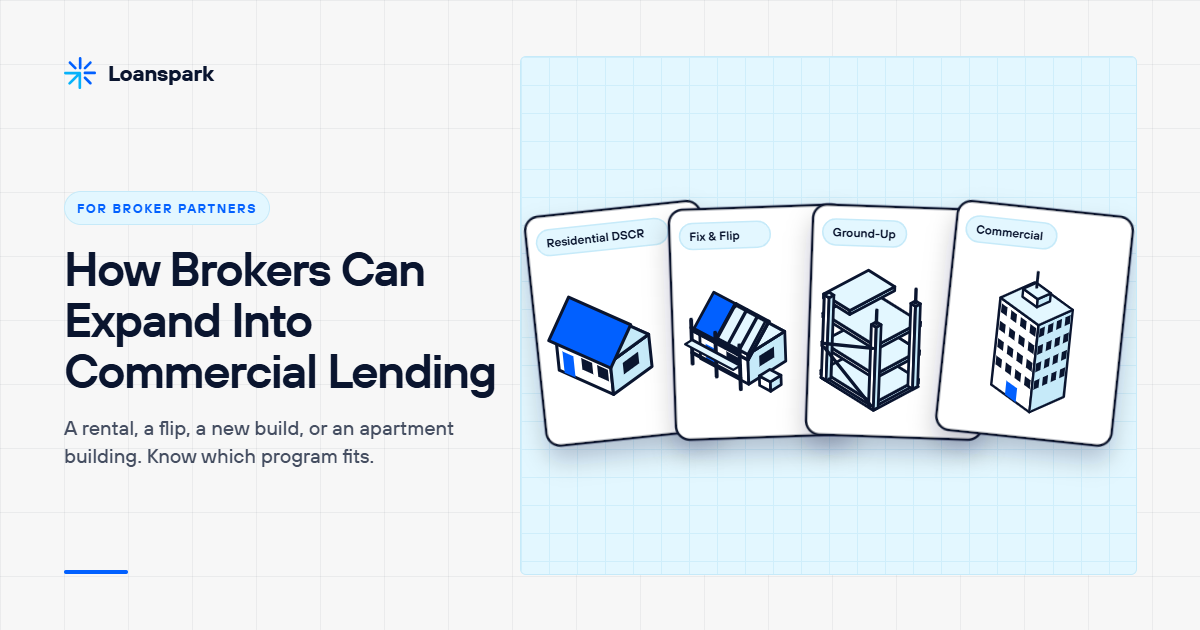
How Brokers Can Expand Into Commercial Lending
Spot commercial and investment property deals in your mortgage pipeline, match them to the right Loanspark program, and know what to prepare first.
How Brokers Use Loan Calculators to Screen Deals
Use Loanspark’s DSCR, Closing Cost and Commercial Loan calculators to test debt coverage, estimate cash to close and model repayment before you submit.

Help Small Business Clients Understand Finances
Help small business clients understand cash flow, financial planning, business credit, and when financing may be worth exploring.
Turn Learning Into Revenue
Start saying yes to more clients with Loanspark’s BLaaS™ platform and Partner Programs