
Business Line of Credit: A Partner's Guide to Faster Client Approvals
See what lenders evaluate in a business line of credit file, and how partners can submit cleaner applications to get clients approved faster.
A client typically qualifies for a Loanspark business line of credit with 24+ months in business, $20,000+ in monthly revenue, a 650+ FICO score, and clean banking activity, with funding possible the same day once the file is complete. Many line of credit applications stall for a simple reason: the business may be a fit, but the submission is not ready for underwriting. Incomplete files, missing documents, and banking histories that haven't been reviewed before submission, these are the friction points that add days to a process that can otherwise close the same day.
As a partner, you can influence much of that outcome before the file ever reaches underwriting. This guide breaks down what lenders are evaluating, what tends to derail a file, and how to identify which clients are worth submitting in the first place.
What Underwriters Are Actually Looking For
A business line of credit is underwritten differently from a term loan. Because it’s a revolving facility, funds drawn, repaid and drawn again, lenders aren’t just assessing whether a business can handle a fixed repayment. They’re evaluating whether it can manage ongoing access to capital responsibly.
Four factors drive most decisions:
Revenue consistency, not just revenue size. The minimum monthly revenue threshold is $20,000, with $35,000 or more placing a file in stronger territory. But the number alone doesn’t tell the full story. Underwriters want to see that deposits are regular and proportional to the business’s stated activity. A business averaging $22,000 per month with stable, predictable deposits will often read better than one averaging $30,000 with erratic cash flow.
Time in business. The floor is 24 months of operating history. Files with 36 months or more are generally stronger and easier to evaluate during underwriting review. Longevity signals that the business has navigated real conditions, slower months, operational pressure, market shifts, and is still running.
FICO score. 650 is the minimum; 660 is where the file starts looking more comfortable. Worth noting for your client conversations: Loanspark uses a soft credit pull, so checking eligibility has no impact on the client’s score. There’s no reason to delay a pre-check.
Banking behavior. This is where files often quietly fall apart. Four months of bank statements reveal much of the story, average daily balance, deposit frequency, NSF events, and negative days. Clean banking activity is one of the most meaningful signals in a submission. If the statements show patterns you wouldn’t want to explain to an underwriter, that’s a conversation to have with your client before you submit.
The Most Common Reason Applications Get Delayed
Incomplete submissions are the single most predictable source of friction in the approval process. The fix is straightforward, but it requires discipline on the front end.
The most frequent gaps:
Missing bank statements. Four months are required. For requests over $100,000, the documentation package expands: most recently filed business tax return, year-to-date P&L and balance sheet, prior-year P&L and balance sheet if taxes are on extension, a current debt schedule, and in some cases a personal tax return. If you're putting together a larger file, gather all of this before starting the process.
No business description. Underwriters need to understand what the business does, how it generates revenue, and who it serves. A missing or vague description adds review time. It's an easy fix that often gets skipped.
NSFs and negative days. Non-sufficient fund events and frequent negative balances are red flags in underwriting and can be disqualifying. If you spot these in your client's recent statements, it's worth a direct conversation before submission rather than after a delay.
Ownership ambiguity. LLC and corporate structures are preferred. Any lack of clarity around ownership or entity structure will slow the file and may require additional documentation.
How to Submit a Stronger File
Loanspark can fund as fast as the same day. That timeline is realistic, but it depends on the file being complete from the start. Running through a pre-submission checklist is the simplest way to avoid delays that don't need to happen.
Standard documentation:
- Basic credit application, completed in full
- 4 months of business bank statements (no gaps, no missing pages)
- Government-issued photo ID
- Voided check or bank letter
- Clear business description
- Entity structure and ownership clearly documented
For requests over $100,000, add:
- Most recently filed business tax return
- YTD P&L and balance sheet
- Prior-year P&L and balance sheet (if taxes are on extension)
- Current debt schedule
- Personal tax return (case-by-case)
One additional step worth taking: review the last four months of bank statements before you submit. You don't need to be an underwriter to spot NSFs, extended negative balances, or irregular deposit patterns. If you see them, expect questions.
Who This Product Works Best For
The business line of credit is designed for established businesses with real, ongoing capital needs — not one-time purchases. The revolving structure is most valuable where cash flow cycles regularly, whether that's inventory timing, seasonal demand, recurring overhead, or short-term operational gaps.
In practice, the product has strong fit across a wide range of industries:
- Healthcare and medical practices: payroll, supply procurement, and equipment cycles create recurring capital needs that a revolving line addresses well
- Restaurants and retail: seasonal inventory shifts and fluctuating cash flow make on-demand access to capital a practical tool, not a luxury
- Manufacturing and wholesale: procurement lead times and fulfillment gaps are a textbook use case for this type of facility
- Service businesses: trucking, HVAC, landscaping, legal services, accounting — businesses with project-based revenue and consistent overhead benefit from the flexibility a line of credit provides
Technology companies, e-commerce operators, and nail salons are also among the most active industry segments for this product.
Who May Not Be a Fit Yet
Part of working effectively as a partner is knowing when a client isn't ready for a particular product. Submitting a file that doesn't meet the criteria doesn't accelerate anything — it creates a declined application and a harder conversation.
Businesses under 24 months old. The minimum time-in-business requirement is firm. This product isn't designed for early-stage companies.
Real estate-focused businesses and restricted industries. This facility isn't structured for real estate entities, and certain industry categories fall outside eligibility.
Businesses with unstable banking activity. Frequent NSFs, extended negative balances, or irregular deposits can make a business a poor fit for this product. If the banking history doesn't support a revolving credit facility, this isn't the right product at this moment — and there may be better alternatives to explore with the client.
Businesses in ineligible states. Lines of credit through this program are not available in North Dakota, South Dakota, or Vermont.
The Product at a Glance
Beyond eligibility, the structure itself is part of the pitch — particularly for clients who've dealt with traditional term loans and expect a slower, heavier process. A few details are worth knowing before you present this option.
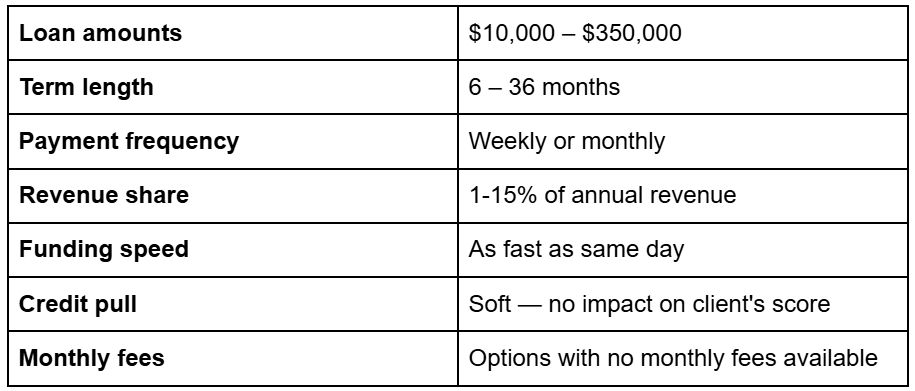
For a qualified client, this also tends to be a product that generates ongoing engagement: once the line is established, there's no need to reapply. Draws and repayments happen within the existing facility, which means less friction every time the client needs to move.
Ready to Submit?
If your client has 24+ months in business, $20,000 or more in monthly revenue, a 650+ FICO, and clean banking activity, they may be a strong candidate for a business line of credit. Submit the required documentation upfront to help the Loanspark team review the file and provide a decision quickly.
Not a partner yet? Apply in minutes and start closing faster deals for your clients.
Questions before you submit? The Loanspark partner team is available at partners@loanspark.com.
Frequently Asked Questions
What's the minimum credit score for a business line of credit?
650 is the minimum; 660 is where a file starts looking more comfortable to underwriters.
How much monthly revenue is required?
$20,000 minimum, with $35,000 or more placing a file in stronger territory.
How long does a business need to be operating to qualify?
24 months minimum; files with 36 months or more are generally stronger.
How fast can a business line of credit fund?
As fast as the same day, once the file is complete and documentation is in order.
Does checking eligibility affect a client's credit score?
No. Loanspark uses a soft credit pull, so pre-checking eligibility has no impact on the client's score.
How is the line repaid?
Through a revenue share of 1–15% of annual revenue, rather than a fixed monthly payment.
Which states are not eligible?
North Dakota, South Dakota, and Vermont.
Explore more blogs to help your lending expertise
DSCR Loans for Brokers: 1–4 Unit Deal Fit Guide
Learn which 1–4 unit investment property scenarios fit Loanspark’s Residential DSCR program, what brokers should prepare, and what changes at 5+ units.

Turn Numbers Into Confidence: How Loanspark’s Calculators Win Clients and Close Deals
Loanspark’s DSCR, Closing Cost, and Loan Calculators turn complex numbers into clear insights, building trust, saving time, and giving you a competitive edge.

The Embedded Lending Blindspot: Why Half of Lenders Are Missing the Future and What We’re Doing About It
We’re in the middle of a financing revolution, and most lenders are still playing catch-up.
Turn Learning Into Revenue
Start saying yes to more clients with Loanspark’s BLaaS™ platform and Partner Programs